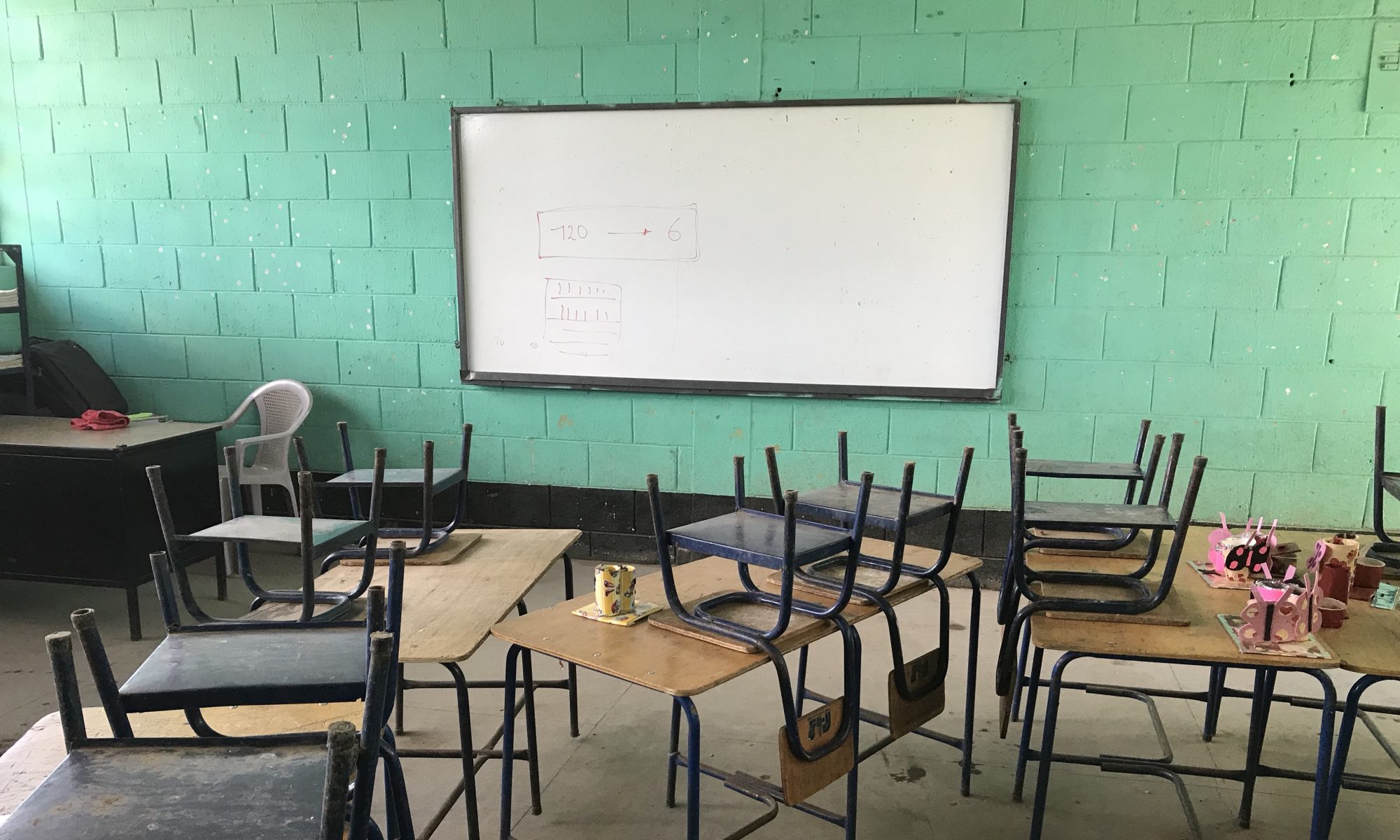
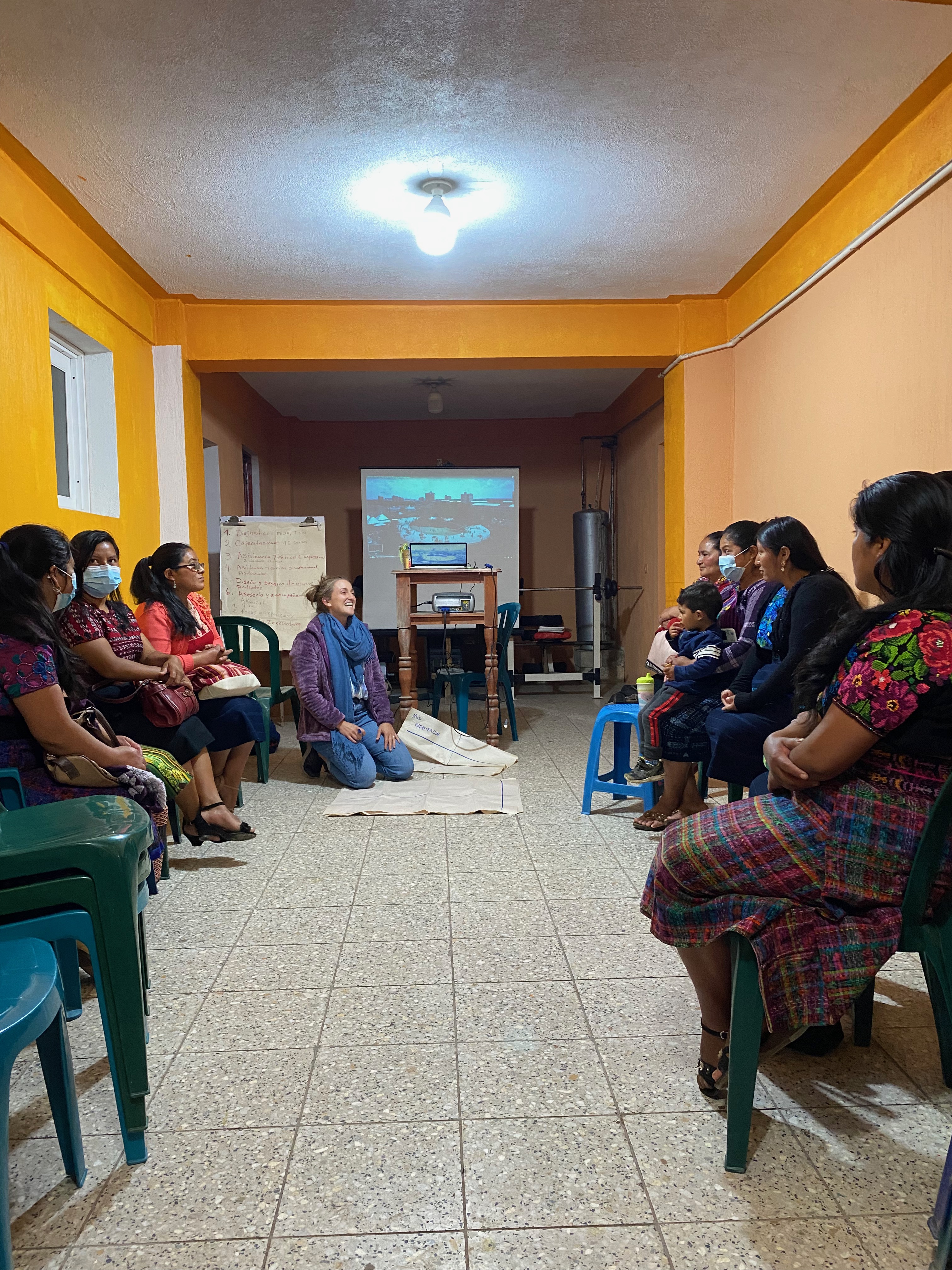
I am an educator at heart, it is the element of this work that brings me joy, and as such, I am constantly working to expand and improve my practice. My years as an educator in universities, in the Chicago Public Schools system and in rural Guatemala, informs my understanding that students, everywhere, are active producers of knowledge. Grounded in these varied experiences, my instructional practice is informed by three core values: the cultivation of collaborative knowledge production, valuing the whole student in all their complexity, and relating our learning to broader pursuits of social justice.
I am immensely grateful to all of the students I have had the opportunity to work and collaborate with.
Listed below are some of the courses I have taught, with course descriptions and links to example student work.
Rutgers University
Latin America: An Introduction (Fall/Spring 2022, 2023, 2024)
Latin America plays an ambiguous role in the Western imaginary. In media coverage, artistic representations, and everyday conversations representations of Latin America in the global north present a place that is simultaneously “vibrant,” “colorful,” and “filled with culture,” while also being “underdeveloped,” “violent” and “backwards.” These stereotyped imaginaries reveal more about the gaze of the global north than they do about the complex and diverse realities of Latin America, its peoples and their histories. The course aims to introduce students to Latin American history, society and culture. As a complicated region full of contrasts, we will approach the breadth and diversity of Latin America with humility, understanding that this course is only an introduction, a place to begin our investigations, exploring the interconnectedness within the region, and its relationship to broader global processes
Migration from Mexico and Central America (Spring 2023)
This seminar will track both the shifts and continuities in migration from Mexico and Central America. Taking the U.S. framing of migration across the southern border as a “crisis” as our starting point, we will work to complicate this “crisis” framing, interrogating the political, economic and social conditions that have generated the emergence and persistence of migration within and from Mexico and Central America. We will explore the mobility of Central American and Mexican peoples following the work of anthropologists, historians, geographers, and political scientists but also through film, art and music. Though a focus on one specific region, this course covers several topics related to migration and mobility including: border construction and militarization, life along the migrant pathway, the political economies of migration, interfamilial bonds and transnational forms of care, racialization, colonialism, citizenship and national identities, environmental change, social violence, as well as the construction and management of migrant categories. We will consider broad questions over the course of the semester, like, how do individuals, families, and communities produce and make sense of the new forms of existence brought forth by migration? Who has the right to migrate, and conversely, what would a right of non-migration might look like? What responsibilities do nation-states have towards mobile peoples? And how might continued human mobility reframe how we understand belonging and rootedness?
University of Pennsylvania
Education, Culture and Society Graduate Seminar (Fall 2021, Spring 2022)
What is the master’s paper? In ECS, you will write an academic paper that draws on a critical review of scholarly literature. Whether on an applied or academic track, the paper serves to demonstrate your emerging expertise in a narrow field – showing that you have understood the evidence and main theories in this area, their strengths and shortcomings, and how they have been applied and developed. A high quality paper takes a stance in this work, and reflects breadth and depth, rigor and consistency, clarity and brevity, effective analysis and synthesis. This writing-intensive, year-long seminar prepares ECS master’s students to cultivate a narrow area of expertise through the preparation of the ECS capstone: an academic paper that demonstrates mastery through a close examination and original synthesis of previous research and argumentation. The course aims to guide you in how a body of knowledge is constituted by in-depth familiarity with a range of interrelated ideas; provide you with systematic and rigorous techniques for analyzing ideas/evidence, finding relationships between ideas, and understanding the nature and use of arguments; provide structured, scaffolded guidance in the development of the strongest possible Master’s Paper that demonstrates the above; and cultivate a critical, but supportive and inclusive community of peers dedicated to your success as a graduate student at Penn.
Anthropology and Education (Spring 2022, Summer 2022)
How does education and schooling come to matter in our contemporary world? How do educational processes, systems and ideologies intersect with concerns around race, ethnicity, class, culture, and power in society? What role does education have in reproducing and/or challenging social structures? And how do education and schooling relate to larger ideas of social justice and equity? These are some of the key questions driving this course on Anthropology and Education. Throughout the semester we will be exploring the social, cultural, and political contexts of education and schooling through a set of anthropological perspectives, theories, and pedagogies to help better understand the educational experiences and realities of young people and their communities.
Through this exploration, this course offers an introduction to the anthropological study of socialization and schooling in cross-cultural perspective. As such, we will pick up one of the central aims of anthropological studies of education: to examine the relationships between education, culture, and society through ethnography. Using anthropological research our starting point, we will examine key issues like citizenship and immigration, race and racialization, neoliberalism and credentialism, as well as social justice and social reproduction. Emphasis will be given to reading ethnographic research closely and critically to uncover the ways that anthropological approaches reveal something about the diversity of human experience. Class discussions and assignments will focus on how research “problems” are conceptualized or theorized, and the relevance of these problems to broader concerns over the role education plays in the construction of contemporary societies what it means to be an “educated person.” We will explore the myriad ways in which schooling and education are both contested terrains and powerful tools, differentially experienced and navigated by diverse actors.
Qualitative Modes of Inquiry (Fall 2015, Fall 2020)–Teaching Assistant
Qualitative Modes of Inquiry is an introduction to qualitative research problems and research design techniques. The course is both seminar and practicum. In weekly class meetings, we will consider the epistemological foundations, pragmatics, and ethics of qualitative field research. Each participant will also develop and conduct an independent research project. To this end, course readings, discussions, and assignments are designed to guide students through various stages of qualitative inquiry, including the development of research problems, conceptual frameworks, plans for data collection and analysis, and a final report. It is expected that the theoretical concerns that arise in class will inform practical and ethical considerations during the course of research, and vice versa. In this sense, the course is a dialogue between theory and practice. By the end of the semester, students should have a critical understanding of: approaches to qualitative research; the limitations and challenges of qualitative inquiry; and practical experience with data gathering techniques such as participant observation and in-depth interviews.
Temple University
Education in the Global City (Spring 2018)
This course explores the relationship between educational processes and the context of the global city. A relatively recent sociological concept, the global city has been broadly theorized as an urban center that wields considerable influence in the world economy. Whether as “command centers” or centers of production, global cities are conceived as hubs of multinational corporate activity, technological innovation, extraordinary diversity, cosmopolitan culture, and economic growth. And yet, despite the idealism that often surrounds them, global cities are also known to harbor pronounced levels of socioeconomic inequality. In both the global North and the global South, cities tend to be places where concentrations of great wealth and extravagance exist alongside extreme degrees of poverty and material deprivation. In our class, this particular contradiction will serve as a broader prism through which we will explore education in the global city.
We begin by considering foundational sociological theories of education and the emergence of Western mass education. Taking a transnational, post-colonial approach, we also explore the historical relationship between education and the construction of the Western European/US empire. From there, we interrogate the historical foundations of globalization, examining how this process has been theorized by different scholars and how it is historically situated in relation to process of Western industrialization, European colonialism/US empire, and decolonization. Taking up the theme of the global city, we explore this concept and the scholarly debates that have arisen around its meaning.
 Briana nichols